


Your shopping cart is empty!

 Home
Home
Linear polarizing filter
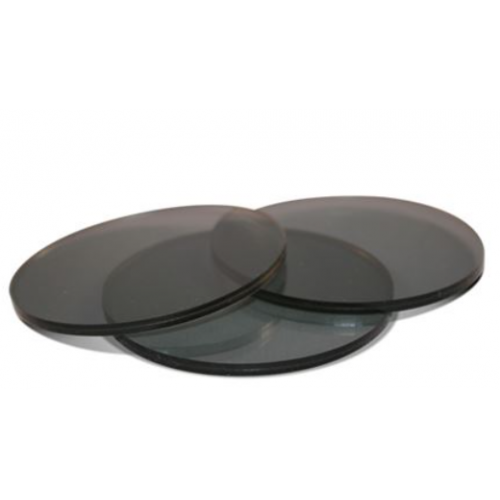
Ear polarizing filters have the following characteristics: 1. Selective Transmission: They allow only light vibrating in a specific direction to pass through, blocking light perpendicular to that direction, thereby separating polarized light. The transmittance depends on the angle between the polarization direction of the incident light and the axis direction of the filter, following Malus' Law. 2. High Extinction Ratio: High-quality linear polarizing filters can achieve an extinction ratio of thousands to even tens of thousands to one, effectively distinguishing polarization states and reducing interference from non-target polarized light. 3. Wavelength Adaptability: Linear polarizing filters made of different materials and designs are suitable for various wavelength ranges, such as visible light (400-700 nm) and near-infrared (750-2000 nm). Some products can extend their applicable spectral bands through coating or material optimization. 4. Diverse Structures: Common types include thin-film, glass laminated, and metallic wire-grid types. Thin-film types are lightweight and flexible; glass laminated types offer high stability; metallic wire-grid types are suitable for applications with high incident angles and broad spectral ranges. 5. Environmental Adaptability: Some products exhibit good temperature and humidity resistance, enabling stable operation within wide temperature ranges (e.g., -20°C to +80°C), making them suitable for complex environments such as industrial and outdoor settings. 6. Versatile Functions: They can be used to reduce glare, enhance image contrast, adjust light intensity, and achieve polarization beam splitting. These filters find widespread application in photography, optical measurement, laser technology, display, and other fields.