


Your shopping cart is empty!

 Home
Home
Pentagonal Prism
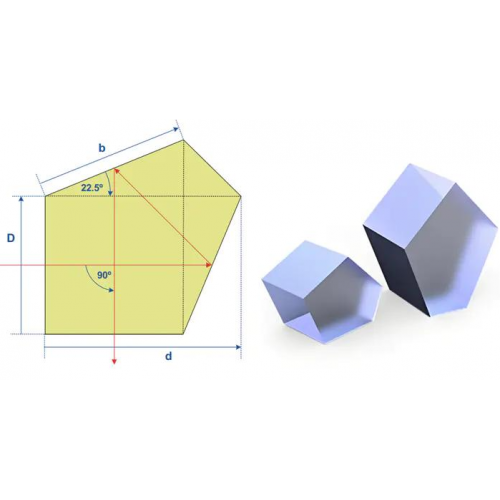
entagonal Prism (also known as a pentagonal prism) has the following characteristics: 1. Geometric Structure: It consists of two congruent pentagonal bases and five rectangular lateral faces, classifying it as a heptahedron with 15 edges and 10 vertices. The lateral faces are perpendicular to the bases, and the lateral edges are parallel to each other. 2. Optical Properties: In optical applications, pentagonal prisms are typically made from transparent materials such as glass. They contain two refracting surfaces at 90° to each other and two reflecting surfaces at 45° angles. This configuration enables incident light to be precisely deviated by 90° after two reflections, without inverting the image or altering its handedness. 3. Stability and Precision: Compared to systems using multiple mirrors, pentagonal prisms are less sensitive to installation errors, allowing for more stable and precise beam steering. They are commonly used in high-precision scenarios such as optical measurements, instrument calibration, and single-lens reflex camera viewfinder mechanisms. 4. Material and Coating: Optical glass (e.g., N-BK7) is typically used as the base material. Reflecting surfaces are coated with reflective materials like aluminum to enhance reflectivity, while the incident and exit surfaces may be coated with anti-reflective coatings to minimize light loss. 6 reference sources