


Your shopping cart is empty!

 Home
Home
Isosceles Right Angle Prism
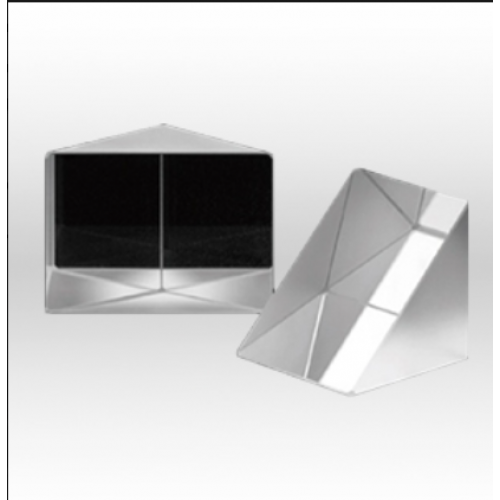
An isosceles right-angle prism is a common optical component with a cross-section shaped as an isosceles right triangle, consisting of two right-angle faces and one hypotenuse face. When light is incident perpendicularly on one of the right-angle faces, it undergoes total internal reflection at the hypotenuse face and then exits perpendicularly from the other right-angle face, achieving a 90-degree deviation of the light path. If light is incident on the hypotenuse face, it undergoes two total internal reflections at the two right-angle faces, resulting in a 180-degree reversal of the light path. Utilizing the principle of total internal reflection, this prism features high reflectivity (up to over 99.9%), compact structure, and good stability. It is widely used in various optical systems such as optical imaging, laser technology, spectral analysis, periscopes, and telescopes for operations like light path turning, image rotation, and reflection.